
One of the few temples to survive within a major city is El Cerrito or the Pyramid of Pueblito. Built over 3,300 years ago it is a testament to the wisdom and knowledge of the ancient people of this area. I was lucky enough to visit it early this week.

El Cerrito has a long history as a religious site and complete with altars and various ceremonial buildings. It is believed that a female deity was worshipped here. One of the plazas on the site, known as the Sculptures Plaza, had two alters one on the west and one on the east sides. Human skulls were found here along with pottery from ancient sites located throughout Mexico. Believe it or not, this was once a very colorful place decorated with highly pigmented colors of red (roja), yellow (amarillo), and blue (azul).
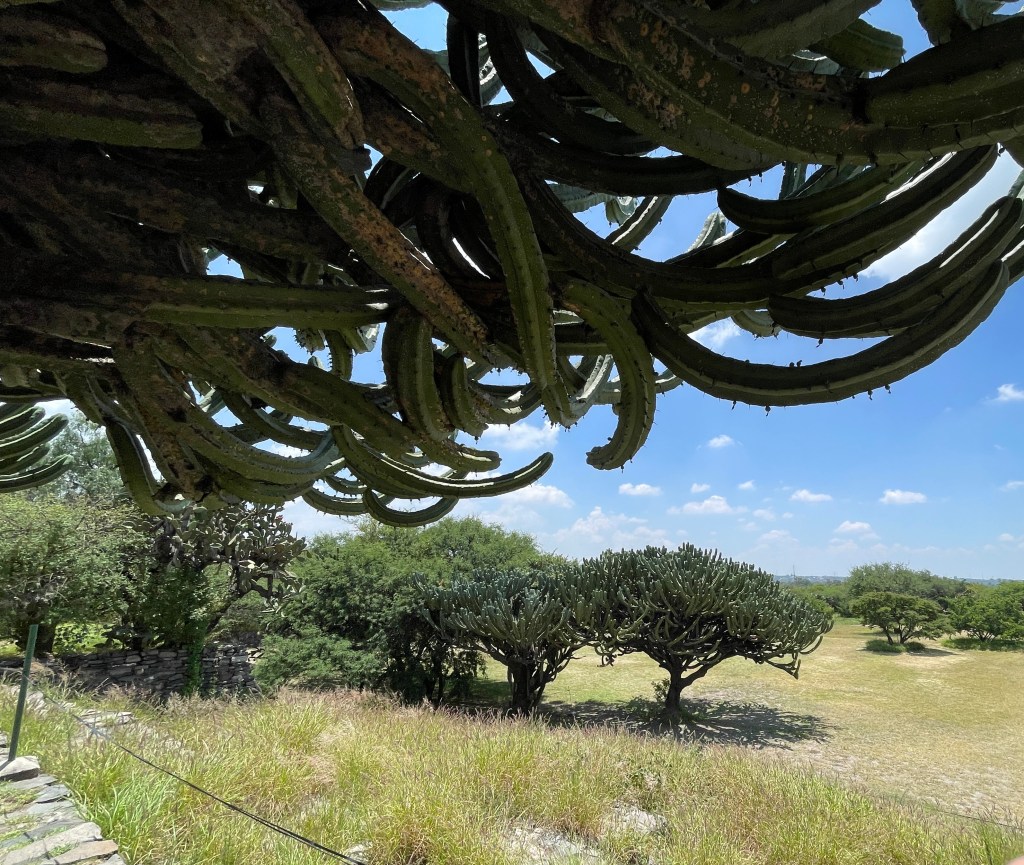
El Cerrito itself was constructed as a step pyramid and was built to resemble a mountain. Unfortunately, it will never be known how tall the temple originally was because in 1887 the Fernandez family built a house at the top of a “hill” shaving at least 2 meters off of the temple. The house was named El Fortin and it remains abandoned at the top of the structure to this day. One cannot blame the Fernandez family for building on top of this important archeological site; for El Cerrito was buried under tons of dirt and covered by trees for centuries until 1941 when the main walls were discovered and work began to preserve the pyramid and try to understand it’s historical importance. And with the very old immense cactus trees that can be found all over the property it is understandable why the temple was hidden for so many years.
For me one of the most amazing things is how the temple is strategically located in order to take advantage of solar alignments and the acoustics of the valley. For instance, as the sun moves across the horizon a beam of sunlight reaching the basement creates a visible sundial on the wall while an analemma pattern is created on the floor which dictates the sun’s seasonal and everyday paths. In spring the equinox creates a time and place where the sun’s beam goes past the vertical sundial and reaches a boundary that lies between the blue and orange tiles on the wall announcing the arrival of the equinox. Further, sound travels directly from and to the temple from the small hamlet of El Pueblito and it is said that you can hear the Catholic priests recite mass.

The Mexican and local government have worked hard to preserve this ancient treasure and there are beautiful walkways and an amazing visitor center on the grounds. The entrance fee is minimal and there is inexpensive parking nearby. This is definitely a great day trip and I would recommend hiring one of the guides whose knowledge of El Cerrito is vast as well as entertaining. Here he is demonstrating to us the echoes of our clapping as they disperse into town.



 You Should Be A Traveling Fool2.com