A Little Bit Of Asian Culture-Corpus Christi, TX

I love it when you stumble upon a place that is unexpected and it turns out to be a feast for the eyes. The Texas State Museum of Asian Cultures in Corpus Christi is just such a place. Located within walking distance of several of the city’s tourist gems, this hidden treasure celebrates the art and culture of such countries as Koran, Sri Lanka, Thailand and Laos.
DSC07875

Founded in the 1960’s by local Mrs. Billie Trimble Chandler, the museum while small, houses collections of the ordinary as well as the extraordinary. While the museum has amassed a sizable collection of paintings, pottery, textiles and more, it also welcomes traveling exhibits from a variety of Asian countries. The museum also offers educational classes for both locals and tourists alike.

DSC07884

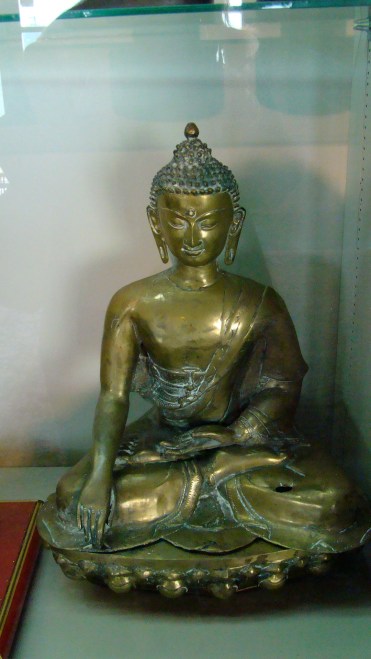
When I was there I saw several intricately embroidered and colorful kimonos on display and the collection of jade from China was vast and diverse. Since I am a collector of Korean Celadon Pottery I appreciated the intricacies of the ones that were shown.  I was also amazed at the berth of the clay Hakata Dolls collection from Japan. How one woman could have collected all of these treasures during her 17 years spent teaching in Japan is beyond me!


One of the biggest assets this small museum has is it’s people. The staff is extremely knowledgable and will spend time pointing out particular pieces and answering any and all questions. Even the hard ones. In fact, I had a question that they staff was unable to answer but researched and emailed me the information that they discovered. Talk about service!

The Texas State Museum of Asian Cultures is located at 1809 N. Chaparral St, Corpus Christi, TX. It is open Tuesday-Saturday 11 a.m.-5 p.m. Entrance fee is $5 per adult and less for students and children. It is about a one hour stop.

Small museums like this are priceless and deserve our support. Stop by…you will be glad that you did!
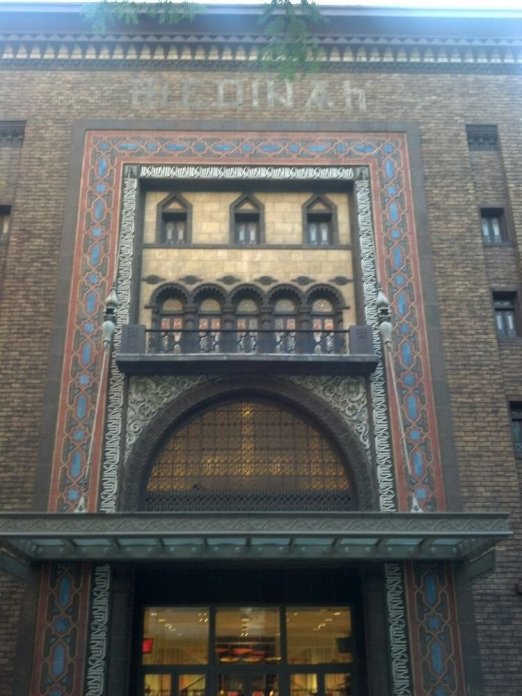


Bloomingdale’s Medinah-Chicago, Illinois

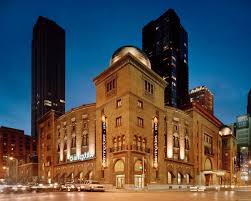
One of my favorite places in Chicago to browse (notice I said browse not shop) is at Bloomingdales Medinah store on Wabash Avenue.

I remember the first time I saw it. I was so stunned that my jaw slacked and my mouth dropped open in surprise as I stared in awe this totally unique and fascinating piece of architecture. It’s not often you run across Moorish Revival Architecture  with onion domes and horseshoe-shaped arches in the middle of an American city but here stood this jewel and I was lucky enough to be able to go in and take a look.  Needless to say, I was intrigued front entrance  where I saw the words “The is no God but Allah” written in Arabic.

o

According to information provided by the store the building was built in 1912 and its intended use was as an auditorium seating over 4,000 people on three levels as well as a meeting hall for the Shriners. The Shrine Circus took place here complete with elephants, tigers and clowns to thrill the crowd. Because the acoustics were so superb, the venue was used for recording by the Chicago Symphony. Concerts and plays were another favorite crowd pleaser.

Like most good things which must come to an end beginning in 2000 the building was gutted and turned into a home furnishing store by Bloomingdales.

100_7499

It is a real treat to “shop” here. Everywhere you look there is something interesting to see. From the domed ceiling to ornate stained glass there are clues to this wonderful buildings past that surround you. And ladies some of the best stained glass windows can be found in the restroom.

If you would like to view some historic photographs of the building visit:

http://westsuburbanshrineclub.org/History-Wabash.htm

Exploratorium-Embarcadero at San Francisco

Billing itself as a public learning laboratory the Exploratorium encourages kids and adults alike to use science, art, and their senses to explore the world around them. Located on the Embarcadero this stunning location on the wharf is worth the cost of admission in and of itself.

DSC03779

The kids will easily want to spend the entire day visiting the hands-on exhibits. During one hour they may spend their time learning how neurons react while actually working with them and perhaps learning about Mars while investigating its many up close and personal images. Many times throughout the day children can take classes in subjects such as model plane building and flying. Rotating exhibits often include astonishing art which encourages visitors to use machines that allow sculptures to change shape and purpose. And using a vocal visualizer will delight your kids as they use their voices to transform laser lights into incredible shapes and patterns. With both inside and outside venues it allows the little ones to burn off some energy easily.

This place is science as it is meant to be explored but mostly it is just a place where your kid can engage in FUN!

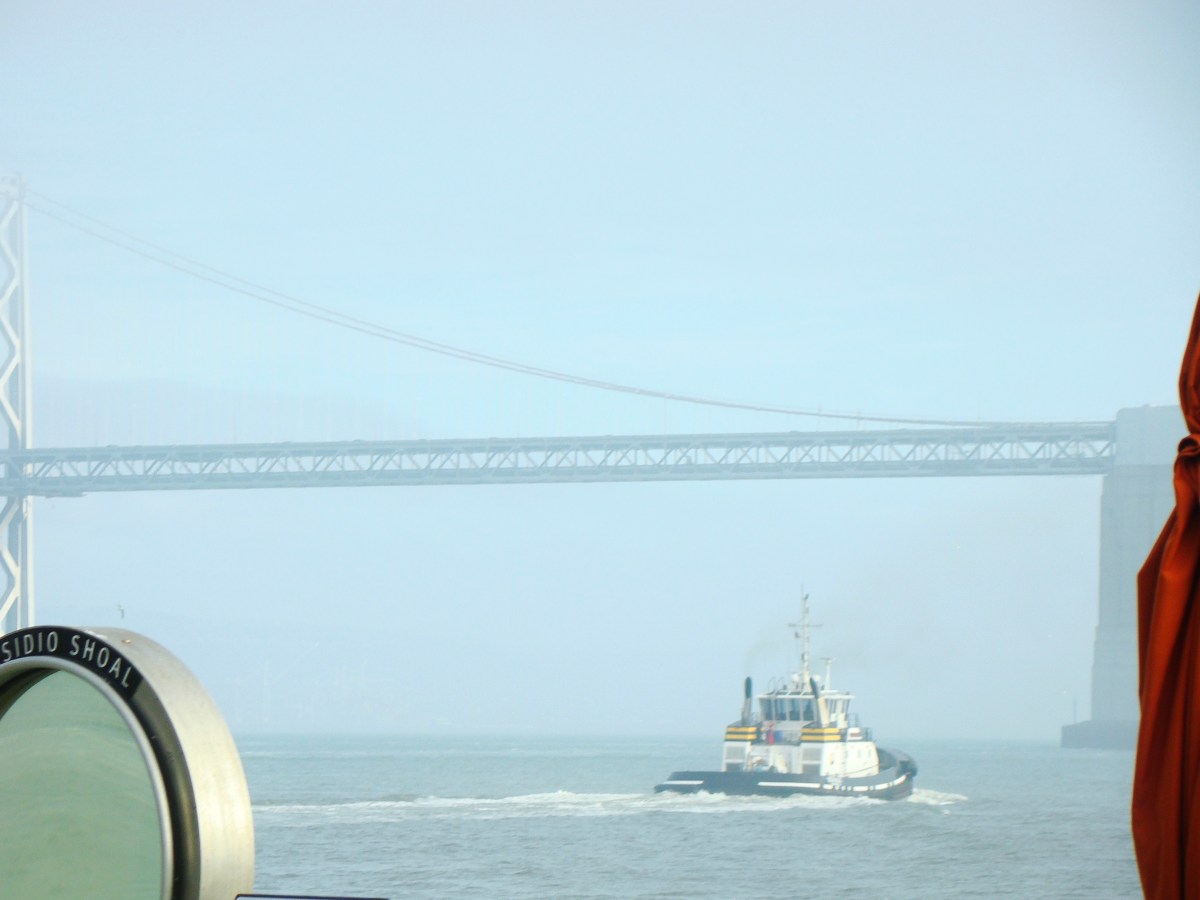
When everyone gets in need of their own fuel you can head down to the eatery. The food is good but be prepared to shell out some dough for fresh salads and homemade mac and cheese. After noshing down head out to one of the decks where you can glimpse the bridge and watch the boats ply the waters.

DSC03934

The Exploratorium also sponsors “After Dark Nights” programs for adults only. Here you can have a lesierly dinner and sip a few cocktails too. Pairings are also offered featuring some of the best organic foods in the area. Obviously, this is a great place to meet like minded folk and I suspect it is probably a better pick up place than the local grocery store!

HINT: Yes, I agree completely that ticket prices of  $29 for adults is a bit pricey but if you invest in a CITY PASS in which discounts are provided to some of the areas favorite tourist sites then you can save 44%. Prices are a little less for youth and FREE to kids 3 and under. But smart San Franciscans wait until the six annual FREE days to visit and California Public School Teachers can receive free entry by filling out a form online. Check the website for dates.

Valkenburg Caves-Valkenburg, Netherlands

What brought us to the charming town of Valkenburg was my 13th G-Grandfather, Jan Van Valkenburg (1515-1575). It was his home town and I wanted to see it. And we did. It was fabulous. But what touched us more were the caves (Cauberg Cavern-Gemeentegrot/Fluweelengrot ) radiating out beneath the center of the city and did they ever have a story to tell. So we listened.DSC05816

You can enjoy the caves either by guided walking tour or by “train.” I would advise walking. The walk is easy not steep and you will be given plenty of time to ask any and all questions that your heart desires.

As for the history of the caves, the Romans began excavating them 2,000 years ago for use as building material in and around the area and significant buildings still stand today as a testament of its worth. The caves have also been used for centuries as a sanctuary for refugees during the French Revolution and more recent wars.

Be sure to step up close to the walls and you will see limestone littered with fossils and shells proof of an underwater world that existed here 100 million years ago. It is fascinating to see all the “fossil gold” left behind.

Yet,  the real treasure in the caves is the art work left by miners and residents of the town  since  before the 1700’s. Drawn in charcoal and created by the dim light thrown off by candles and later, lanterns, these works of art depict a living history of what was known or imagined by these dedicated artisans.  In addition to the paintings there are also huge statues carved into the walls throughout the entire labyrinth of corridors that run under the city.

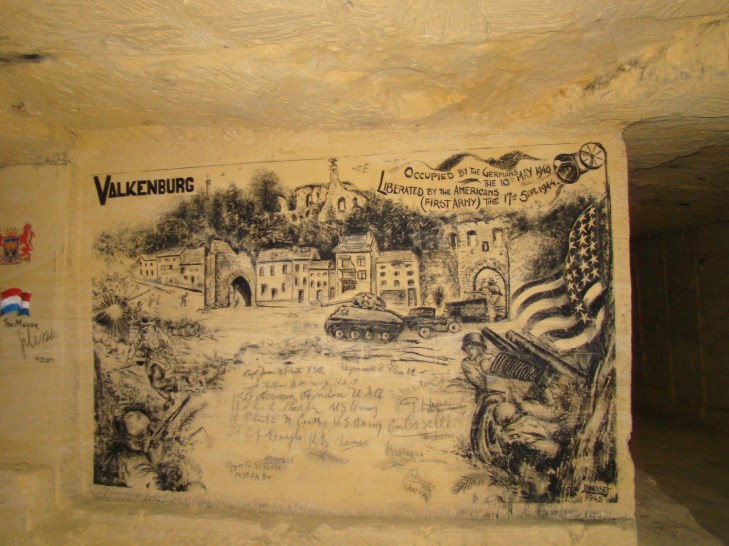
But perhaps the most compelling picture is the Liberation of the City by the Americans in on September 17, 1944. It is a tribute to those brave men who worked to reclaim this city from the Germans and deed her once again to its citizens. And below the painting you will find the signatures of some of the soldiers who participated in the liberation.

DSC05866

But perhaps even more astonishing is this fact: that during the 10-day battle the towns 10,000 residents all lived in the caves together while fierce fighting raged in the streets. It gives you pause as you wander with your guide thinking about what it must have been like underneath the city not knowing if you might live or die.

At the end of the tour you will be lead to another set of tunnels in which various eras of artwork are projected onto the walls of the cave creating a living-breathing art show that  surrounds you and disorientates you at some level.Very cool!

DSC05887

While we did not visit during Christmas it is my understanding that a huge Christmas Market is held on weekends during the weeks prior to the holiday. Here you will find crafts and fine works of art offered for sale by local craftsmen.

Entrance fee about 5 Euros

Hint: Wear a jacket as it is chilly deep underground.